
Preschool Gymnastics: What 4 and 5 year olds really learn in class
The first seven seconds
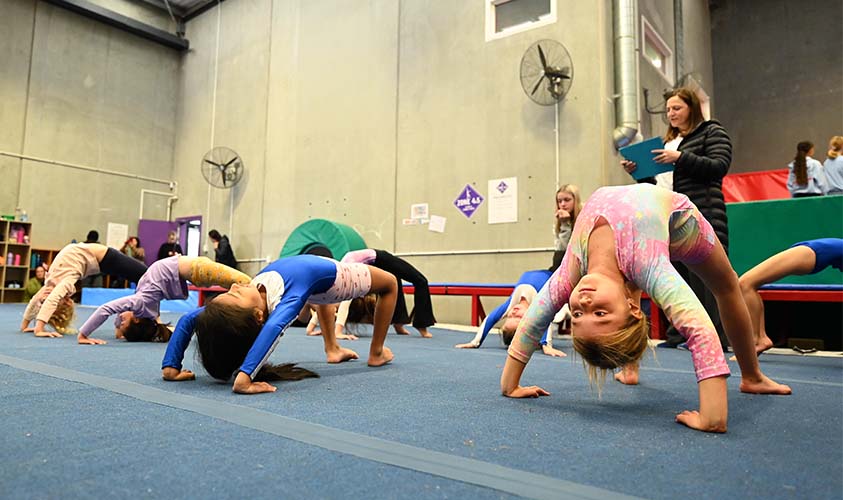
There’s a moment every parent recognises when they first bring their child into a preschool gymnastics class. They stand quietly at the edge of the gym, watching the coach clap their hands and cheerfully call the children into a circle. In your head you picture neat lines, listening ears, careful turns, and small athletes soaking up every instruction.
For about seven seconds, that picture holds.
Then one child sprints the other way. Another refuses to sit because “the mat feels funny.” A third gets upset because someone took their favourite coloured spot. A small daredevil scales equipment they were absolutely not meant to touch yet, while another clings to your leg, wondering if coming inside was a mistake.
To an adult, it can look like chaos. To an experienced preschool coach, it looks just like four and five year olds doing what four and five year olds do.
______
No time? Here’s the quick take-away for busy parents
- Preschool gymnastics builds self-regulation as much as physical skill. Your child learns to wait, listen, manage frustration and try again.
- Development at this age swings from week to week. A child who walks the beam on Monday might refuse it the next week. That fits the age.
- A quiet child on the edge of the group is often still learning. Watching counts as taking part.
- One coach guides about eight to ten children at once. Preschool gymnastics works as group learning, not a private lesson.
- Confidence grows when a child chooses to try something hard. Pressure from an adult tends to set it back. Children read your nerves. Calm support, with no comparisons, helps more than coaching from the sideline.
_____
Your child is learning more than gymnastics
Preschool gymnastics teaches more than gymnastics. Underneath every jump, roll, climb and balance, your child practises how to function on their own in a structured space. The physical skills matter, for sure, but the bigger work happens around them.
A young child in the gym learns to manage uncertainty. They wait for a turn. They listen over the noise of a busy room. They cope with frustration, try again after a fall, and find their place in a group away from the comfort of home. They work out where their body should sit in space, how to control it, and how to judge a risk. That is a heavy load for a developing brain.
Harvard’s Center on the Developing Child makes the point that children are not born with skills like focus, self-control and working memory. They build the foundations across early childhood, through experience and the support of the adults around them. A gymnastics centre, with its turns to wait for and its nerve to find, gives them that practice.
Why “good listening” isn’t the whole story
Adults link learning with visible compliance. A child who sits still and follows instructions looks like they are learning. A distracted or teary child looks like they are struggling. In reality, young children rarely work that way. A child rolling around at the side may take in every word. Another might need a few weeks to feel safe enough to join. Some learn by diving in. Others learn by watching first, then having a go when they feel ready.
Development at this age is uneven, and that’s normal
Your child might cross the beam with a grin one week and refuse to go near it the next. They might separate from you with ease for three classes, then cry at the door the following week for no clear reason. That swing is part of being four or five. Children this age are still building impulse control, attention span, emotional regulation and social confidence. Expecting steady focus from a prechooler asks a lot of a brain that is still under construction.
What a great preschool coach is really doing
A good preschool coach does far more than teach forward rolls. They read personalities, adjust activities, manage the energy of the group, and help each child stretch without tipping into overwhelm. They hold encouragement and boundaries at the same time. And they do all of it while stopping someone from climbing the apparatus upside down.
One thing helps to know as you watch. A coach keeps eyes on a group of around eight children for the whole class. In our Orange Programme for 4 and 5 year olds, you watch from the viewing area while the children work as a group. No child gets the full 45 minutes of one-on-one attention. We draw children in through modelling and gentle guidance. We will not push a child to attempt a skill before they feel ready.
Confidence grows through safety and choice
Real confidence shows up when a child feels safe enough to try something hard because they want to. Encouragement supports that. Pressure works against it. A child who feels cornered might comply in the moment, often at the cost of trust.
Larry Lauer, a sport psychologist with the Institute for the Study of Youth Sports at Michigan State University, points out that a parent may apply no pressure at all, “it is only the perception of the athlete that they are being pressured” (Association for Applied Sport Psychology). Children can feel it long before we notice.
Growth still needs a little discomfort. Children stretch when they do something that feels new or a bit scary. The skill is telling the difference between helping a child through that and overwhelming them. Carol Dweck’s research at Stanford shows children praised for effort and strategy keep going when things get hard, while children praised for being clever or talented back away from the challenge. Praise the effort your child shows when something feels hard.
Bravery wears different faces. Sometimes it looks like jumping into the foam pit alone for the first time. At others it is walking into the gym without holding your hand. Sometimes it is joining the warm-up after sitting out for ten minutes, or watching this week so they feel ready next week. Those quieter wins count too.
The part parents play
You shape this more than you might think. Young children read adult emotion with great sensitivity. They pick up anxiety or pressure before a word is said. Research on how children take their emotional cues from a parent shows they look to your face and voice to decide how to feel about something new. When we focus on performance or comparison, children feel it.
Comparison helps no one at this age, because preschoolers develop at very different rates. One child is fearless on the apparatus but sensitive to noise. Another follows every instruction but finds coordination hard. Another bounces off the walls like a caffeinated squirrel and turns into a fine gymnast later. No single personality predicts who thrives.
Sport NZ’s Balance is Better takes a similar view of youth sport. Good experiences balance “winning and the pressure to perform, with getting an opportunity, getting better, and enjoying sport”. The children who do well over the long run tend to be the ones who feel supported and safe enough to keep trying, not the ones who look most advanced at four.
This matches what the American Academy of Pediatrics tells parents. Most children are ready for organised sport at around six, and benefit from plenty of free play before then. As paediatrician Dr Kelsey Logan puts it, “the interest should start with the child, not the parent”.
What to look for next time you watch
Next time you settle into the viewing area, holdon to the bigger picture. The coach is supporting and supervising the wholegroup. Each child follows their own development path. A child who sits out hasnot failed. They are taking it in, even when it looks like nothing ishappening.
Curious about gymnastics for your 4 or 5 year old? Our programme in Hobsonville and Kumeu runs in 45-minute classes through term time. Book a trial and watch your child find their feet.
_____
Frequently asked questions
What age can my child start gymnastics?
Most children join preschool gymnastics between 3 and 5. Before about age six, the focus sits on fundamental movement and confidence rather than formal skills. The American Academy of Pediatrics notes that most children are ready for organised sport around six, and benefit from plenty of free play before then.
My child won’t join in. Are they wasting the class?
No. Watchingfrom the side is how some children learn. Many need a few weeks to feel safe before they fully partake, and plenty of processing happens even when participation does not.
Why doesn’t the coach work one-on-one with my child?
A coach supervises around eight to ten children for safety and group learning. Each child gets attention in turn, not the full 45 minutes alone. That is by design.
Will gymnastics make my child more confident?
Over time, yes, when confidence grows from safe, voluntary challenge. Forced participation tends to cost trust and confidence rather than build it.
My child was brave last week and clingy this week. Should I worry?
No. Development at this age is uneven. That inconsistency is normal and rarely signals a problem.
What if my child seems behind the others?
Preschoolers develop at very different rates. The children who thrive long term are usually the ones who feel supported and keep trying, not the ones who look most advanced at four.
How can I help from the sidelines?
Stay calm and skip the comparisons. Children sense adult anxiety and pressure. Warm, low-key support helps most.
What should I look for in a good preschool gymnastics class?
Coaches who balance encouragement with boundaries, never force a child, and keep the focus on fun and development over performance.
_____
Sources
• Harvard University, Center on the Developing Child — Executive Function & Self-Regulation
• American Academy of Pediatrics — AAP Encourages Organized Sports (Dr Kelsey Logan)
• Association for Applied Sport Psychology — Keeping Perspective in Youth Sport (Dr LarryLauer)
• Stanford Report — Carol Dweck on effort, praise and children’s growth
• Sport NZ — Balance is Better
• National Center for Biotechnology Information - Parental Socialization of Emotion (NIH / PMC)
Next in the Knowledge Hub
The XPG hub for quality science and education around movement, gymnastics and nutrition

Register for a trial!
Experience the joy of gymnastics and watch your child thrive in a fun, safe environment. Book a trial session today to find the class that's best suited to your child's age and experience.
